
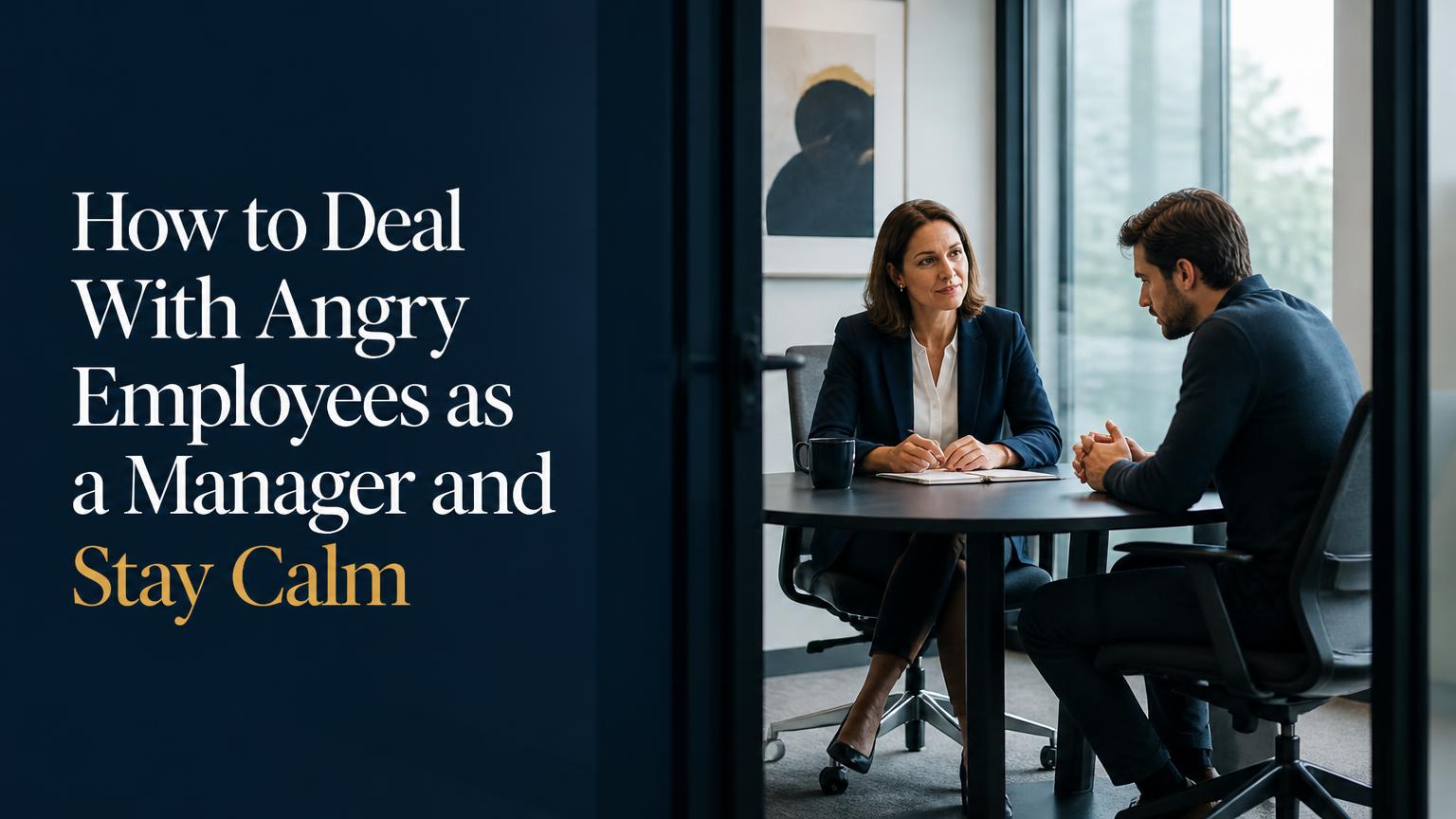
Anger at work can unsettle an entire team, especially when a manager feels personally challenged or pressured to resolve the situation immediately. An employee may be reacting to unfair treatment, unclear expectations, workload, a personal difficulty, or a problem that has been ignored for too long. The manager’s task is not to suppress emotion or win an argument. It is to stay composed, understand what is happening, protect respectful workplace standards, and move the conversation toward a workable next step.
How to Deal With Angry Employees as a Manager
#1. Regulate Your Own Response First
Before responding, slow yourself down. An angry employee may speak sharply, interrupt, raise their voice, or make accusations. If you match that intensity, the conversation can quickly become a contest rather than a problem-solving discussion. Take one breath, lower your speaking pace, and remind yourself that responding calmly is part of your managerial responsibility.
Staying calm does not mean appearing passive or accepting disrespect. It means choosing your response instead of reacting automatically. Keep your posture open, avoid sarcastic expressions, and use a steady tone. If you are too angry to think clearly, suggest a short pause rather than continuing the discussion while both people are reactive.
You can say:
I can see that this is important to you. I want to understand what happened, and I also want us to discuss it respectfully. Let’s slow down so we can have a productive conversation.
This approach acknowledges the seriousness of the issue without agreeing with every accusation or surrendering your authority.
#2. Move the Conversation to a Private Setting
If an employee becomes angry in a team meeting, on a sales floor, or in an open office, avoid conducting a detailed investigation in front of colleagues. Public discussion can embarrass the employee, encourage spectators, and make it harder for everyone to speak honestly. If the situation allows, move to a private room or arrange a separate meeting soon afterward.
Do not use privacy as a way to isolate or intimidate the employee. Choose a suitable location, keep the conversation professional, and consider involving another manager or HR representative if the issue is serious or the employee has made a complaint about you. If there are threats, physical intimidation, or immediate safety concerns, prioritize safety and follow your organization’s established procedures.
A simple transition might be:
I don’t think we can handle this fairly in front of the team. Let’s move to a private room and discuss what happened. If now is not a good time, we can schedule a meeting for later today.
The goal is to protect dignity while creating conditions for a more useful conversation.
#3. Listen for the Specific Concern
Anger is often broad at first: “Nobody listens here,” “You always give me the worst assignments,” or “This whole process is ridiculous.” Do not argue with the general statement immediately. Listen for the concrete event, decision, or pattern behind it. Ask calm questions that turn a complaint into information you can assess.
Useful questions include:
- “What specifically happened?”
- “When did this occur?”
- “Who was involved?”
- “What outcome were you expecting?”
- “Has this happened more than once?”
- “What would a fair resolution look like to you?”
Take notes when the issue involves workload, scheduling, performance feedback, potential harassment, discrimination, safety, or another matter that may require follow-up. Listening does not require you to validate an unproven claim. You can acknowledge the employee’s experience while reserving judgment about the facts.
I hear that you felt singled out when the schedule was changed. I’d like to understand which shift changes you’re referring to and what information you received at the time.
This distinction helps you address the actual problem rather than reacting to the emotional surface of the conversation.
#4. Acknowledge the Emotion Without Automatically Agreeing
Employees generally need to know that their concern has been heard before they can consider solutions. Acknowledgment is not the same as accepting blame or confirming that the employee’s interpretation is correct. It simply recognizes the employee’s experience and the seriousness of the conversation.
Use language that is specific and measured. “I can see why that deadline felt difficult” is different from “You’re right, management treated you unfairly.” The first recognizes the pressure; the second reaches a conclusion before you have reviewed the facts.
You might say:
I understand why you’re frustrated. You were told the project would have more support, and that support did not arrive when expected. I need to review what was communicated and what changed before deciding what should happen next.
Avoid minimizing phrases such as “Calm down,” “You’re overreacting,” or “It’s not a big deal.” These statements usually shift attention away from the workplace issue and toward the employee’s manner. If the behavior is unacceptable, address that separately and clearly.
#5. Set Boundaries Around Disrespectful Conduct
Managers should make room for strong disagreement, but they do not have to tolerate threats, insults, shouting over others, discriminatory language, or intimidating behavior. A fair workplace allows employees to challenge decisions without permitting conduct that prevents a productive discussion or makes others feel unsafe.
State the boundary in terms of observable behavior. Avoid labels such as “You are being aggressive” or “You have an attitude.” Instead, describe what is happening and what must change. This gives the employee a clear opportunity to correct the conduct.
You can disagree with the decision, and I am willing to discuss the reasons. I will not continue the conversation while I am being shouted at. If we can speak without personal insults, we can continue now; otherwise, we will pause and reconvene with another manager present.
Follow through consistently. If the behavior continues, end the conversation calmly and document what occurred. Do not threaten punishment in the moment or make promises about disciplinary consequences. Use the organization’s normal procedures and seek guidance from HR or an appropriate senior manager when needed.
#6. Separate the Valid Issue From the Unacceptable Delivery
An angry presentation can contain a legitimate workplace concern. An employee may be wrong about some details but still identify a real scheduling problem, inconsistent instruction, excessive workload, or communication failure. Conversely, a valid concern does not excuse threats or personal attacks. Managers must evaluate both parts separately.
After the conversation, write down two sets of observations:
- The issue: What decision, process, event, or condition is the employee challenging?
- The conduct: What did the employee say or do during the discussion?
Then assess the issue using available records, relevant policies, schedules, messages, performance information, and accounts from people directly involved. Avoid deciding based solely on confidence, volume, seniority, or your personal impression of the employee.
A useful response might be:
Your language toward me was not acceptable, and we will address that separately. You also raised a concern about unequal weekend assignments. I’m going to review the recent schedules and come back to you with what I find.
This balanced approach protects accountability without allowing poor delivery to hide a legitimate management problem.
#7. Agree on Follow-Up and Document the Outcome
A difficult conversation should end with clarity about what happens next. Summarize the concern, explain what you will do, identify any action expected from the employee, and set a reasonable time for follow-up. Do not promise an outcome you cannot control. Promise only the steps you can actually take.
For example, you may agree to review workload distribution, clarify a performance expectation, correct a communication error, arrange a meeting with HR, or revisit a decision after obtaining more information. Put important agreements in writing, particularly when the discussion concerns recurring conflict, performance, conduct, or a formal complaint.
You can close with:
To summarize, you’re concerned that the new reporting process adds work without enough training. I’ll review the time required with the team leads and send you an update by Thursday. In the meantime, please use the current form and bring any specific problems to me rather than trying to resolve them during the team meeting.
Follow-up demonstrates that listening had a purpose. It also creates a record that helps prevent misunderstandings and lets you assess whether the problem has been resolved or is part of a continuing pattern.
A Practical Conversation With an Angry Employee
A productive conversation usually has four stages: describe the purpose, hear the employee’s account, clarify expectations, and agree on next steps. Do not begin with a long defense of your decision. If you speak for most of the meeting, you may miss information and reinforce the employee’s belief that management is not listening.
Before the meeting, gather the relevant facts and decide what authority you have. You may be able to change a schedule, clarify a process, or provide support immediately. You may need approval for a broader change. Knowing the difference helps you avoid defensive promises and makes your response more credible.
A manager could open the conversation this way:
I asked to meet because the discussion in this morning’s meeting became tense, and I also want to understand the concern you raised about the project deadline. I’d like to hear your account first, then we can separate the immediate issue from the way the discussion was handled.
Please walk me through what happened from your perspective. I may ask questions so I can check the details. After that, we’ll discuss what needs to change and what follow-up is appropriate.
If the employee interrupts repeatedly, return to the structure rather than competing for control:
I want to hear that point, and I’ll make sure we get to it. Let me finish this question first so I can understand the timeline.
If the employee remains hostile, restate the boundary once and pause the meeting if necessary. A manager does not need to reach agreement in one conversation. The immediate objective may simply be to establish enough calm and clarity for a fair next step.
When Anger Reveals a Management Problem
Sometimes the employee’s anger is connected to a decision the manager should reconsider. A strong reaction does not prove that the employee is right, but it may point to unclear communication, inconsistent treatment, inadequate resources, or a decision that created avoidable strain. Managers should be willing to examine their own role without becoming defensive.
Ask yourself:
- Was the expectation communicated clearly and early enough?
- Have similar employees been treated in the same way?
- Did the employee receive the information or support needed to succeed?
- Was feedback based on observable work rather than assumptions about attitude?
- Did the team understand why the decision was made?
- Have I allowed this concern to continue without addressing it?
If you find that you contributed to the problem, acknowledge it directly. A brief, specific admission is stronger than an elaborate justification.
I reviewed the messages, and I was not clear about who owned the final approval. That contributed to the delay. I’m sorry for the confusion. From now on, I’ll confirm the owner and deadline in writing after each project meeting.
An apology does not eliminate accountability, and correcting a management mistake does not mean every employee demand must be accepted. It shows that fairness applies to managers as well as employees.
When to Involve HR or Another Manager
Some situations should not be handled alone. Seek guidance when the conversation involves threats, potential harassment or discrimination, retaliation concerns, safety issues, repeated serious misconduct, a formal complaint, or a conflict in which your own conduct is being challenged. You may also need support when the employee’s behavior is escalating despite clear boundaries.
Involving HR or another responsible resource is not automatically a punishment. It can provide a more impartial process, help protect everyone’s rights, and ensure that documentation and next steps are handled consistently. Explain to the employee what will happen next without making unsupported claims about consequences.
Because you’ve raised a formal concern about how the schedule was assigned, I’m going to involve HR so the issue can be reviewed properly. I’ll provide the information I have, and you’ll have an opportunity to explain your experience directly.
Continue to treat the employee professionally after involving others. Do not gossip about the incident, reduce opportunities unfairly, or allow the complaint to influence unrelated decisions. The manager’s responsibility is to maintain appropriate standards while allowing the concern to be reviewed on its merits.
Closing Thoughts
Dealing with an angry employee as a manager requires both composure and firmness. Listen for the specific issue, acknowledge the employee’s experience without prejudging the facts, set clear limits on disrespectful conduct, and separate the substance of a complaint from the way it was delivered. Then document the discussion and follow through on agreed actions. A calm response is not weakness; it is a practical way to protect fairness, preserve accountability, and improve the chance of solving the real workplace problem.