
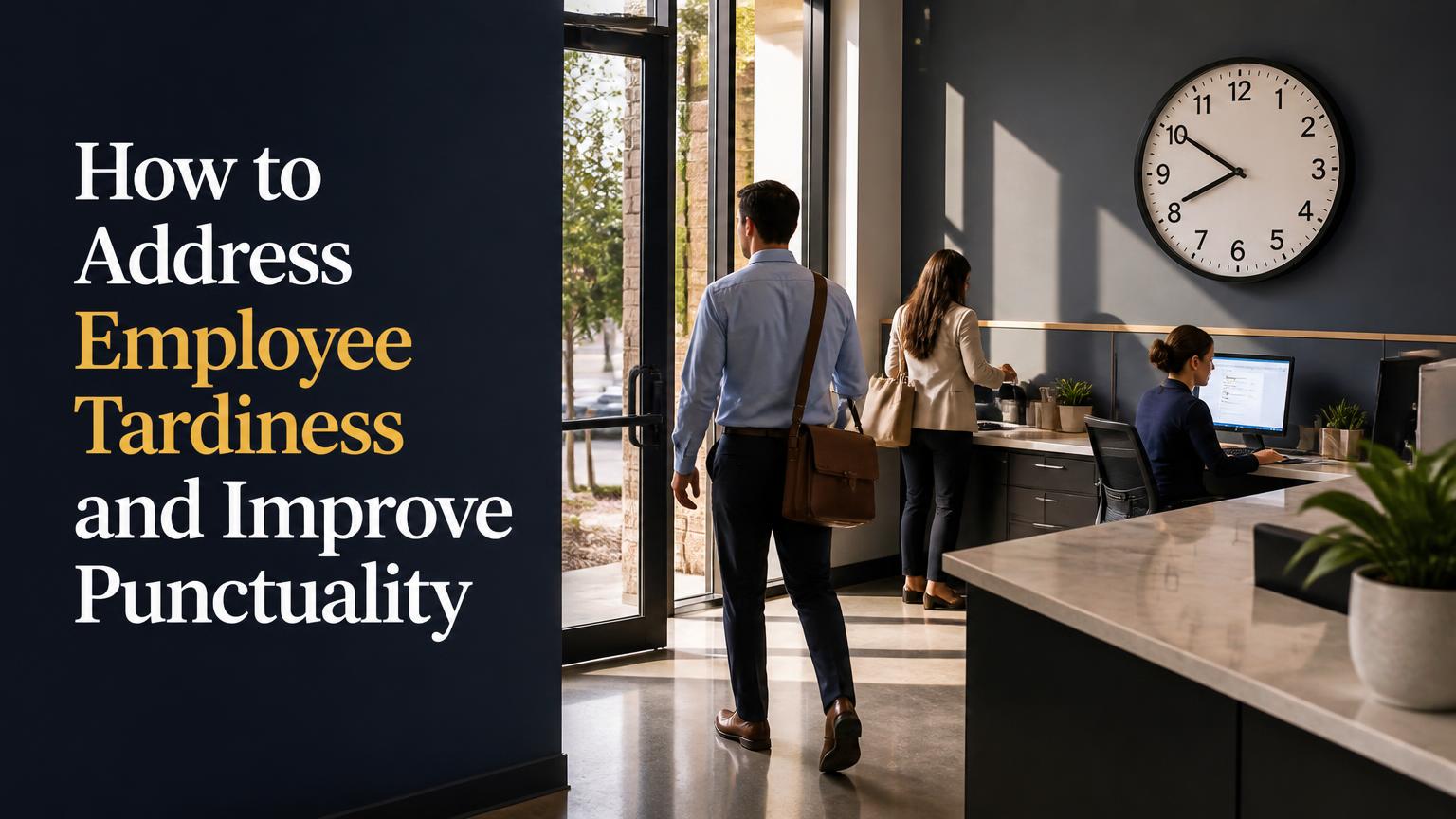
Employee tardiness can disrupt daily operations, delay important tasks, and place additional pressure on coworkers who arrive on time. For managers and supervisors, addressing repeated lateness requires more than simply reminding employees to be punctual. It involves understanding the reasons behind the behavior, communicating expectations, and establishing a fair approach to accountability.
The most effective way to address employee tardiness is to identify attendance patterns, discuss the issue privately, and agree on measurable improvements. By combining clear expectations with reasonable support and consistent follow-up, managers can improve punctuality without unnecessarily damaging employee relationships or workplace morale.
How to Address Employee Tardiness and Improve Punctuality
Addressing employee tardiness requires a structured approach that balances operational needs with individual circumstances. Occasional lateness may warrant a simple conversation, while repeated attendance problems require closer attention and a more formal improvement process.
The following seven steps help managers address punctuality problems constructively while maintaining consistent workplace standards.
#1. Identify and Document Patterns of Employee Tardiness
Before addressing an employee’s punctuality, establish whether the problem involves an isolated incident or a recurring pattern. A single late arrival caused by an unexpected transportation delay is different from an employee arriving 15 minutes late several times each week.
Review available attendance records and identify the dates, scheduled start times, and actual arrival times. Consider whether the employee’s lateness affects customer service, team meetings, production schedules, or other responsibilities.
For example, a retail supervisor might notice that an employee scheduled to open the store at 9:00 a.m. regularly arrives between 9:10 and 9:20 a.m. This creates additional work for coworkers who must prepare the store without sufficient assistance.
Accurate documentation helps managers discuss specific incidents rather than relying on impressions or complaints from other employees.
When reviewing attendance information, consider:
- How frequently the employee arrives late.
- Whether the lateness follows a recognizable pattern.
- Whether the employee provides advance notice.
- How the delays affect coworkers and business operations.
- Whether similar attendance expectations apply consistently across the team.
Avoid assuming that repeated tardiness automatically indicates a poor work ethic. Establish the facts before drawing conclusions.
#2. Arrange a Private Conversation With the Employee
Once a pattern becomes apparent, arrange a private meeting with the employee. Addressing punctuality problems in front of coworkers can create embarrassment, defensiveness, and unnecessary tension.
Begin the conversation by describing the observed behavior without making assumptions about the employee’s attitude or intentions.
For example, a manager might say:
I’ve noticed that you’ve arrived after your scheduled start time on four occasions over the past two weeks. I’d like to understand what’s contributing to this and discuss how we can improve your punctuality going forward.
Allow the employee to explain their perspective. They may be experiencing transportation difficulties, misunderstandings about scheduling, or challenges involving responsibilities outside work.
Listen carefully without immediately accepting every explanation as justification for continued lateness.
The purpose of the conversation is to establish a shared understanding of the problem and identify a practical way forward.
Maintain a calm, professional tone. Employees are generally more likely to participate constructively when they understand that the discussion concerns specific attendance expectations rather than a judgment about their character.
#3. Understand the Reasons Behind Repeated Lateness
Different causes of tardiness require different responses. An employee who misunderstands their shift schedule needs a different solution from someone who repeatedly underestimates their commuting time.
Ask open-ended questions that encourage the employee to explain relevant circumstances without feeling pressured to disclose unnecessary personal information.
Useful questions include:
- What has been making it difficult to arrive at your scheduled start time?
- Are there recurring obstacles affecting your commute or morning routine?
- Is there anything about your current schedule that needs clarification?
- What changes could help you arrive consistently on time?
For example, an employee might explain that a recent public transportation schedule change makes their usual arrival time unreliable.
In that situation, the manager could discuss whether an alternative shift is operationally feasible or whether the employee can adjust their travel arrangements.
However, managers should avoid promising schedule changes before confirming that they are permitted and practical.
Understanding the cause does not mean removing accountability. It allows managers to choose an appropriate response rather than applying the same solution to every situation.
Where an employee raises a potentially protected personal circumstance, follow the organization’s applicable procedures and involve HR when appropriate.
#4. Communicate Clear Attendance and Punctuality Expectations
Employees need to understand exactly what punctuality means in their workplace. Expectations should be specific enough to prevent misunderstandings and consistent with established organizational policies.
For example, an employee scheduled to begin work at 8:30 a.m. should know whether that means being present at the workplace, logged into the relevant systems, or ready to perform assigned duties at that time.
Clarify the employee’s scheduled start time, attendance reporting procedures, and responsibilities when unexpected delays occur.
A manager might explain:
Your shift begins at 8:30 a.m., and we need you ready to start your assigned duties at that time. If an unexpected delay occurs, please notify your supervisor as soon as possible using our usual attendance reporting process.
Explain why punctuality matters for the particular role.
For a customer service employee, late arrival might leave incoming inquiries unanswered. For a production worker, it could delay a scheduled handover. For an administrative employee, it might affect a morning coordination meeting.
Connecting expectations to operational consequences helps employees understand the practical importance of arriving on time.
Avoid creating informal rules that conflict with existing policies, scheduling arrangements, or applicable working-time requirements.
#5. Develop a Practical Plan to Improve Punctuality
When tardiness continues, work with the employee to establish a realistic improvement plan. The plan should identify the expected behavior, actions the employee will take, any appropriate support, and how progress will be reviewed.
For example, a supervisor might agree on the following expectations with an employee who has repeatedly arrived late:
- Arrive ready to begin work at the scheduled 9:00 a.m. start time.
- Review transportation arrangements to allow for ordinary commuting delays.
- Notify the supervisor promptly when an unexpected delay occurs.
- Follow the agreed attendance procedures consistently.
- Review attendance progress after two weeks.
The plan should focus on observable results rather than attempting to control the employee’s personal routine.
If the employee identifies a legitimate scheduling obstacle, consider whether reasonable adjustments are available within operational and organizational constraints.
For instance, moving a shift from 8:00 a.m. to 8:30 a.m. might resolve a recurring transportation conflict without disrupting business operations. Such changes should be approved through the appropriate process rather than granted informally.
Record significant agreements when warranted so both parties understand what improvement looks like.
A good improvement plan establishes accountability while giving the employee a reasonable opportunity to succeed.
#6. Monitor Attendance and Provide Constructive Feedback
After establishing expectations, monitor the employee’s attendance over an appropriate review period. Consistent follow-up demonstrates that punctuality is an ongoing workplace requirement rather than a temporary concern.
Use the same reliable attendance records and standards applied when identifying the original problem.
If the employee improves, acknowledge that progress.
For example:
I’ve noticed that you’ve arrived on time for every scheduled shift over the past two weeks. I appreciate the improvement because it has helped our morning handovers run more smoothly.
Specific feedback reinforces the behavior the manager wants to see.
If punctuality remains inconsistent, arrange another private conversation. Review the agreed expectations, identify any remaining obstacles, and determine whether the improvement plan needs adjustment.
Avoid focusing exclusively on failures. Recognizing sustained improvement helps maintain a constructive working relationship.
At the same time, do not overlook repeated lateness simply because the employee performs well in other areas. Strong performance does not automatically eliminate the operational consequences of unreliable attendance.
The objective is consistent, sustainable improvement rather than a brief period of compliance immediately after a meeting.
#7. Apply Consistent Accountability and Escalate When Necessary
When repeated tardiness continues despite clear expectations, reasonable support, and follow-up, managers may need to consider further action under organizational procedures.
Begin by reviewing the employee’s attendance history, previous conversations, documented agreements, and progress during the improvement period.
Determine whether expectations were communicated clearly and applied fairly. Consider whether relevant circumstances have changed or require additional review.
Depending on the organization’s policies and the manager’s authority, further action might involve a documented coaching conversation, a formal attendance improvement process, or referral to HR.
For example, an employee who repeatedly arrives late despite several documented discussions may need a formal review of attendance expectations and possible consequences.
However, managers should not invent disciplinary procedures or promise outcomes that organizational policy does not support.
Consistency is especially important. If two employees have comparable attendance problems, their situations should be assessed using the same standards while accounting for legitimate differences in circumstances.
Avoid threatening employees, publicly criticizing them, or imposing arbitrary penalties.
The purpose of accountability is to establish reliable attendance and protect workplace operations. Formal consequences, when appropriate, should follow established procedures rather than frustration or personal judgment.
Common Mistakes Managers Make When Addressing Employee Tardiness
Even when managers have legitimate concerns about punctuality, the way they address the issue can determine whether the situation improves or becomes more difficult.
One common mistake is waiting too long before discussing repeated lateness. When managers overlook attendance problems for several weeks, employees may reasonably become uncertain about how strictly the schedule is enforced. A timely conversation helps clarify expectations before the pattern becomes established.
Another mistake is treating every late arrival as deliberate misconduct. Transportation disruptions, scheduling misunderstandings, and unexpected personal responsibilities can affect punctuality. Managers should establish the relevant facts before deciding on an appropriate response.
Inconsistent enforcement can also create problems. If one employee receives repeated warnings while another employee’s comparable lateness is ignored, coworkers may perceive the attendance policy as unfair. Differences in circumstances may justify different responses, but managers should be able to explain the workplace reasons for their decisions.
Public criticism is another avoidable error. Discussing an employee’s lateness during a team meeting or making sarcastic comments in front of colleagues rarely produces a constructive solution.
Finally, managers sometimes focus entirely on documenting problems without establishing a clear improvement process. Attendance records are useful, but they should support conversations, decisions, and follow-up actions.
The strongest approach combines early intervention, consistent expectations, respectful communication, and appropriate accountability.
How to Prevent Employee Tardiness Across the Team
Preventing recurring tardiness requires more than addressing individual employees after problems occur. Managers should examine whether scheduling practices, communication procedures, and workplace expectations support reliable attendance.
Step 1. Establish Clear Attendance Standards
Make scheduled start times and attendance reporting expectations easy to understand. Explain what employees should do when unexpected delays occur and which communication channels they should use.
Include relevant expectations in onboarding and routine team communications. Where an organization already has an attendance policy, reinforce that policy rather than creating competing informal rules.
Step 2. Communicate Work Schedules in Advance
Provide employees with schedules as early as reasonably possible, following applicable organizational requirements.
Frequent last-minute changes can create confusion, especially when employees coordinate transportation, childcare, or other commitments.
Use a reliable scheduling system and make sure employees know how to confirm changes. When a shift adjustment is necessary, communicate it directly and allow employees to raise practical concerns through the appropriate process.
Step 3. Review Recurring Scheduling Difficulties
Look for patterns that suggest a broader scheduling problem rather than isolated employee behavior.
For example, if several employees regularly struggle with an early shift following a public transportation timetable change, managers may need to review whether current staffing arrangements remain practical.
Not every schedule can be adjusted, particularly in operations requiring fixed coverage. Nevertheless, understanding recurring obstacles can help managers evaluate feasible alternatives without compromising business needs.
Step 4. Encourage Early Communication About Delays
Employees should know how to notify their supervisor when an unexpected delay occurs.
Explain that advance communication helps managers adjust coverage, reassign urgent tasks, and reduce disruption. It does not automatically excuse repeated lateness or replace the requirement to meet scheduled start times.
Supervisors should respond professionally to genuine notifications. Employees may become reluctant to communicate problems if every report produces an angry reaction, even when they follow the correct procedure.
Step 5. Reinforce Punctuality Through Consistent Management Practices
Managers influence attendance standards through their own behavior and decisions.
Start meetings on schedule, communicate changes promptly, and apply established expectations fairly. Acknowledge improvements when employees correct recurring attendance problems.
Avoid rewarding employees simply for meeting basic requirements in ways that create unfairness or conflict with company policies. Instead, make reliable attendance part of normal performance conversations and operational planning.
Consistent management practices help employees understand that punctuality is an established workplace expectation rather than a rule enforced only when a supervisor becomes frustrated.
When Should Employee Tardiness Be Referred to HR?
Not every punctuality issue requires HR involvement. Many isolated or straightforward attendance problems can be resolved through normal supervisory conversations and clear expectations.
However, HR involvement becomes appropriate when repeated lateness may require formal disciplinary action, when an employee raises circumstances that need specialized review, or when managers are uncertain about the correct organizational procedure.
For example, an employee may disclose a disability-related scheduling concern or request an adjustment connected to a protected circumstance. Managers should avoid making unsupported judgments about the request and instead follow the organization’s established review process.
HR may also need to assist when attendance expectations appear to be applied inconsistently, when previous interventions have failed, or when a dispute develops over documented attendance information.
Before escalating, managers should organize relevant records, including scheduled hours, actual attendance, previous discussions, and agreed improvement measures. Documentation should remain factual, proportionate, and appropriately confidential.
Involving HR should not automatically be presented as a punishment. Its purpose may be to ensure that the situation receives a fair, consistent, and procedurally appropriate response.
Managers should also recognize the limits of their authority. Decisions involving formal warnings, changes to employment arrangements, or other significant consequences may require approval beyond the immediate supervisor.
Closing Thoughts
Addressing employee tardiness effectively requires a balance between understanding individual circumstances and maintaining dependable workplace standards. Managers should begin with accurate attendance information, communicate concerns privately, and establish clear expectations before considering stronger interventions.
The most useful first step is to identify the specific pattern of lateness and arrange a constructive conversation with the employee. From there, a measurable improvement plan and consistent follow-up can help turn expectations into reliable attendance.
Punctuality improves most sustainably when employees understand what is required, receive appropriate support, and recognize that attendance standards are applied fairly across the workplace.