
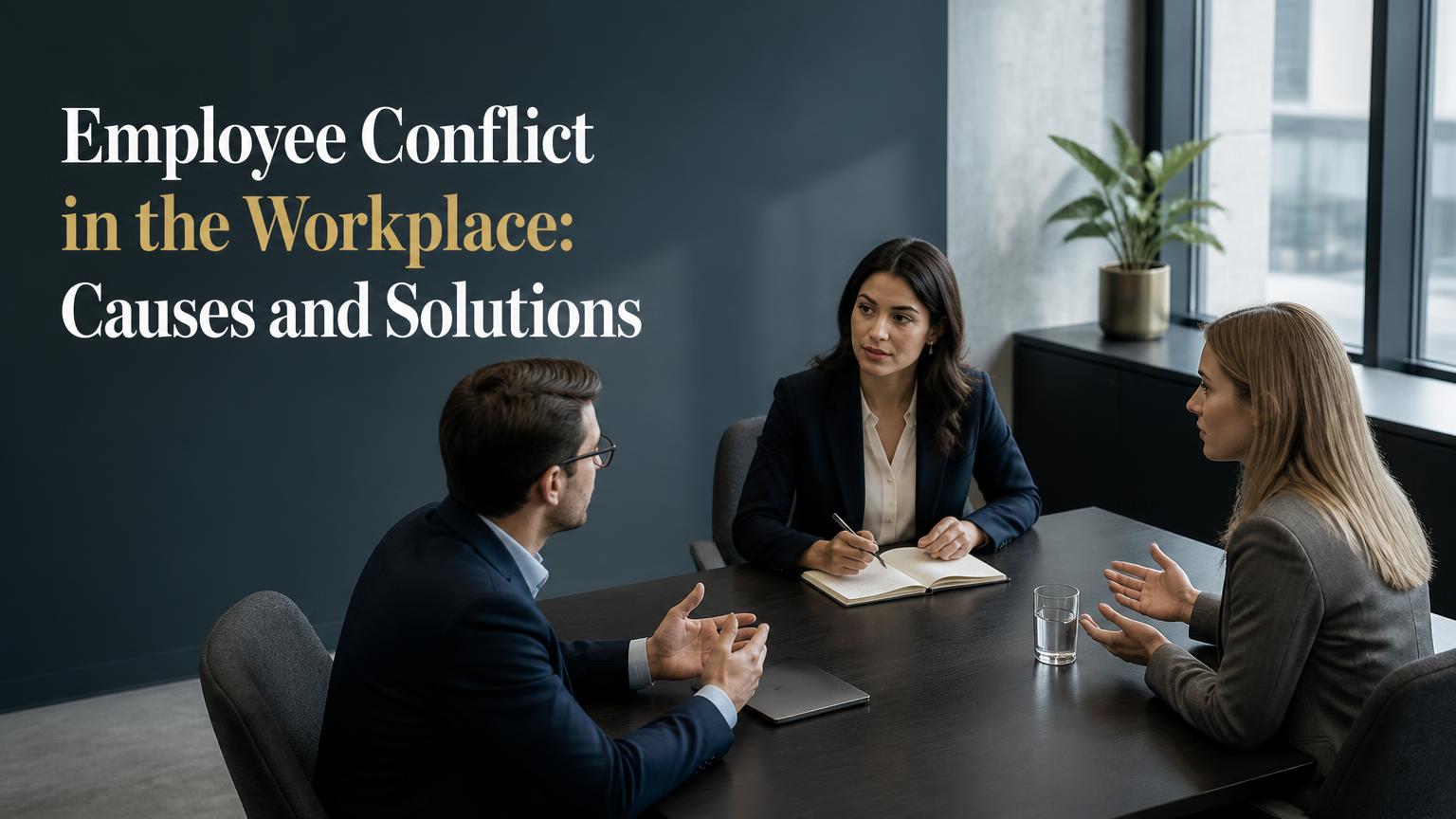
Employee conflict in the workplace occurs when colleagues disagree over responsibilities, communication, expectations, decisions, or personal working styles. Some disagreements are normal and can lead to better decisions. However, unresolved conflict can damage trust, interrupt daily operations, and make collaboration increasingly difficult.
For managers, resolving conflict requires understanding its causes and addressing problems before they become established patterns. Employees also have an important role in communicating concerns and maintaining professional relationships. The most effective approach is to identify the underlying issue, encourage constructive discussion, establish fair expectations, and follow up to ensure the disagreement does not continue affecting the team.
Causes of Employee Conflict in the Workplace
Workplace disagreements rarely develop without a reason. They often begin with ordinary operational problems, such as unclear instructions or competing priorities, before becoming personal. Recognizing the underlying cause helps managers and employees address the actual problem rather than reacting only to the visible disagreement.
#1. Poor Communication Between Employees
Poor communication is one of the most frequent sources of workplace disagreement. Employees may misunderstand instructions, interpret messages differently, or make assumptions about what colleagues expect from them.
For example, a supervisor asks two employees to prepare a customer presentation but does not explain who should complete each section. Both employees assume the other person is responsible for gathering the supporting information. When the deadline approaches, frustration develops and each employee blames the other.
The problem began with unclear communication rather than deliberate misconduct. Managers can reduce similar disagreements by defining responsibilities, confirming important instructions, and encouraging employees to ask questions before misunderstandings escalate.
#2. Unclear Roles and Responsibilities
Conflict becomes more likely when employees do not understand where their responsibilities begin and end. Overlapping duties can create disagreements about decision-making authority, task ownership, and accountability.
Consider two department coordinators who both believe they are responsible for approving changes to a project schedule. One makes an adjustment without consulting the other, who interprets the decision as interference.
Neither employee necessarily intends to create conflict. The organization has failed to establish clear boundaries.
Managers should clarify who owns each responsibility, who contributes to decisions, and when consultation is required. Written role descriptions and agreed project responsibilities can prevent recurring disputes.
#3. Differences in Working Styles
Employees often approach the same assignment in different ways. Some prefer detailed planning and frequent progress updates, while others work independently and make adjustments as tasks develop.
These differences can create tension when colleagues depend on each other.
For instance, an employee who prefers structured schedules becomes frustrated with a teammate who completes assignments close to the deadline. Meanwhile, the teammate feels unnecessarily monitored by repeated requests for updates.
Neither working style is automatically wrong. The conflict arises when employees have incompatible expectations about collaboration.
Agreeing on deadlines, communication frequency, and quality standards allows colleagues to retain reasonable flexibility without disrupting shared responsibilities.
#4. Unequal Distribution of Work
Employees may become resentful when they believe their workload is consistently heavier than that of their colleagues.
Imagine a customer service team in which one experienced employee regularly handles complicated complaints while others receive simpler assignments. Although the arrangement initially seems efficient, the experienced employee eventually feels unfairly burdened.
The disagreement may appear to concern individual colleagues, but the underlying problem is how responsibilities are allocated.
Managers should examine actual workloads rather than relying on impressions. Task complexity, employee experience, available capacity, and other responsibilities all matter when evaluating fairness.
Where imbalances exist, redistributing assignments or providing additional support can prevent resentment from developing into open conflict.
#5. Competition for Recognition and Advancement
Competition can motivate employees to perform well, but it may also create conflict when recognition, promotions, or desirable assignments appear limited or unfairly distributed.
For example, two employees contribute to a successful project, but only one receives public recognition from management. The overlooked employee begins questioning whether their colleague has taken credit for shared work.
The resulting tension can affect future cooperation.
Managers can reduce this problem by explaining how performance is evaluated, acknowledging individual and collective contributions accurately, and applying advancement criteria consistently.
Employees should also have opportunities to discuss concerns about recognition without having to challenge colleagues personally.
#6. Personality Differences and Interpersonal Friction
Employees do not need to become friends to work effectively together. However, differences in communication preferences, temperament, and social expectations can create friction.
An outspoken employee may regularly interrupt meetings because they are eager to contribute. A quieter colleague may interpret these interruptions as dismissive or disrespectful.
Over time, the quieter employee stops participating, while the outspoken colleague becomes frustrated by the apparent lack of engagement.
Managers should focus on observable behavior rather than labeling either employee as difficult.
Establishing meeting rules, encouraging balanced participation, and discussing the effect of interruptions can improve cooperation without requiring employees to change their personalities.
#7. Perceived Favoritism and Unfair Treatment
Employees may become frustrated when they believe managers apply different standards to different team members.
For example, one employee regularly receives flexible scheduling arrangements while another employee’s similar requests are rejected without explanation.
There may be legitimate reasons for the difference, but a lack of transparency can create suspicion.
Perceived favoritism can also damage relationships between employees, even when the colleague receiving favorable treatment has done nothing inappropriate.
Managers should apply workplace standards consistently, explain decisions where appropriate, and protect confidential personal information. Employees need to understand the general principles behind decisions, even when individual circumstances cannot be disclosed.
#8. Disagreements About Decisions and Priorities
Employees sometimes disagree because they have different views about the best way to achieve a shared objective.
A sales employee may want to prioritize a customer’s urgent request, while an operations employee argues that accommodating it would delay several existing commitments.
Both perspectives may be reasonable. The disagreement becomes problematic when each person assumes the other is unwilling to cooperate.
Managers can help by identifying the shared business objective, examining operational constraints, and establishing who has authority to make the final decision.
A structured discussion allows employees to challenge ideas constructively without turning professional disagreements into personal disputes.
#9. Lack of Accountability for Poor Performance
Conflict may develop when one employee repeatedly fails to meet agreed responsibilities and colleagues must compensate.
For example, a team member regularly submits incomplete reports, forcing another employee to correct the information before sending it to customers.
The colleague performing the corrections eventually becomes frustrated, particularly if management does not address the recurring problem.
The issue should not be reduced to a personality clash. It concerns performance expectations and the effect of missed responsibilities on others.
Managers should investigate the reasons for the performance gap, establish measurable improvements, provide appropriate support, and review progress. Employees should not be expected to resolve persistent performance problems through personal confrontation alone.
#10. Workplace Gossip and Rumors
Gossip can turn minor disagreements into wider workplace conflicts by encouraging employees to form opinions based on incomplete or unverified information.
Suppose an employee hears that a colleague criticized their performance during a management meeting. Rather than checking what happened, the employee begins avoiding the colleague and discussing the allegation with others.
A misunderstanding may then spread across the team.
Managers should discourage speculation about colleagues, address harmful conduct when it occurs, and encourage employees to raise concerns through appropriate channels.
Employees can also help by refusing to circulate unverified claims and discussing genuine work-related concerns directly when safe and appropriate.
#11. Limited Resources and Competing Demands
Employees may experience conflict when several people depend on the same limited resources, including equipment, budgets, meeting rooms, or specialist support.
For example, two project teams need the same technical specialist to meet important deadlines. Each team believes its assignment deserves priority.
Without an agreed allocation process, frustration may be directed toward colleagues rather than the resource constraint.
Managers should establish transparent priorities, assess the consequences of delays, and communicate allocation decisions clearly.
Where possible, they can adjust schedules or redistribute resources. When capacity genuinely cannot meet demand, acknowledging the limitation is more constructive than expecting employees to negotiate competing priorities indefinitely.
#12. Resistance to Organizational Change
Changes in technology, reporting structures, responsibilities, or established procedures can create uncertainty and disagreement.
An experienced employee may prefer an existing workflow, while a newer colleague supports a recently introduced system. Each believes the other’s approach creates unnecessary problems.
The conflict may reflect different experiences with the change rather than unwillingness to cooperate.
Managers should explain the purpose of the change, provide relevant training, invite practical feedback, and clarify which procedures are mandatory.
Employees should have opportunities to identify implementation problems without being characterized as resistant simply because they raise concerns.
How to Resolve Employee Conflict in the Workplace
Resolving employee conflict requires more than asking colleagues to get along. Managers need a fair process that establishes what happened, addresses the underlying issue, and restores workable professional relationships.
The following seven steps provide a practical approach for handling disagreements while maintaining accountability and respect.
#1. Identify the Specific Source of the Conflict
Begin by determining what the employees actually disagree about. A visible argument may concern a missed deadline, but the underlying cause could be unclear responsibilities, unequal workloads, or repeated communication failures.
Speak with the employees involved and examine relevant information before reaching conclusions.
Ask questions such as:
- What happened, and when did the disagreement begin?
- Which responsibilities or expectations are disputed?
- How has the situation affected the work?
- What would need to change for cooperation to improve?
Separate observable facts from interpretations. This prevents the resolution process from becoming an exercise in deciding whose personality is more difficult.
#2. Speak With the Employees Privately
Private conversations allow employees to explain their perspectives without feeling pressured to defend themselves in front of colleagues.
Arrange individual discussions when appropriate, particularly if emotions are elevated or accounts of the incident differ.
A manager might begin by saying:
I understand there has been some disagreement about how the project responsibilities are being handled. I would like to hear your perspective, understand what has happened, and identify what we can do to improve the situation.
Listen without promising a particular outcome before reviewing the facts.
If the concern involves serious misconduct, follow the organization’s appropriate reporting or investigation procedures rather than treating it as an ordinary interpersonal dispute.
#3. Encourage Constructive Discussion
When appropriate, bring the employees together to discuss the problem and identify a workable solution.
Explain the purpose of the conversation and establish expectations for respectful participation. Employees should describe specific events, explain their effects, and avoid unsupported accusations about each other’s intentions.
For example, instead of saying, “You never cooperate,” an employee could explain, “I received the updated figures after the agreed deadline, which delayed my report.”
The second statement identifies a concrete problem that can be addressed.
Managers should guide the discussion toward shared responsibilities and future conduct. A joint meeting is not appropriate in every situation, particularly where safety, intimidation, or serious misconduct concerns require a different process.
#4. Establish Clear Expectations and Boundaries
Once the problem is understood, clarify what each employee is expected to do differently.
Vague agreements such as “communicate better” rarely provide enough direction.
Instead, establish specific working arrangements. For example, employees might agree that project updates will be shared every Tuesday, changes to deadlines must be communicated promptly, and disagreements about priorities will be referred to the project manager.
Explain who owns each task and who makes decisions when responsibilities overlap.
Expectations should be reasonable, consistent with organizational procedures, and within the employees’ authority to fulfill.
Clear boundaries help prevent the same disagreement from recurring under slightly different circumstances.
#5. Agree on Practical Solutions
Involve employees in identifying solutions whenever the circumstances allow.
People are more likely to cooperate when they understand the reasoning behind an agreement and have an opportunity to raise practical concerns.
If conflict developed because one employee consistently received urgent assignments, possible solutions might include redistributing tasks, adjusting deadlines, or introducing a shared workload schedule.
Choose actions that address the cause rather than simply reducing visible tension.
Record significant agreements when appropriate, including responsibilities, deadlines, and how progress will be reviewed.
A solution should be realistic enough to implement within the team’s existing resources and operating requirements.
#6. Provide Support and Maintain Accountability
Some conflicts cannot be resolved through conversation alone. Employees may need additional training, clearer instructions, better resources, or management support to meet expectations.
For instance, recurring disagreements about incomplete handovers may indicate that employees lack a consistent process for transferring information between shifts.
Introducing a standard handover procedure could solve the operational problem.
However, support should not eliminate accountability. If an employee continues to disregard reasonable expectations after receiving appropriate guidance, the manager should address the behavior through established performance or conduct procedures.
Apply standards consistently and distinguish genuine capability problems from deliberate refusal to follow reasonable instructions.
#7. Follow Up and Monitor the Working Relationship
An initial agreement does not guarantee that the conflict has been resolved.
Schedule a reasonable follow-up conversation to review whether employees are meeting their commitments and whether the original problem has improved.
Look for observable changes, such as fewer missed handovers, clearer task ownership, timely communication, and more reliable cooperation.
Ask employees whether the agreed arrangements are working and whether further adjustments are necessary.
Avoid expecting colleagues to become personally close. The objective is a professional relationship that allows them to work respectfully and effectively.
If problems persist, reassess the underlying cause and determine whether additional management intervention is required.
The Effects of Unresolved Employee Conflict
Unresolved disagreements can affect more than the employees directly involved. When conflict continues, colleagues may spend time avoiding each other, questioning decisions, or compensating for communication failures. Routine assignments become more complicated because employees hesitate to share information or collaborate.
Team performance may also suffer. Projects can be delayed when employees refuse to coordinate, duplicate work, or disagree repeatedly about responsibilities. Other team members may feel pressured to take sides, creating divisions that extend beyond the original dispute.
Persistent conflict can also undermine confidence in management. Employees who believe legitimate concerns are consistently ignored may become less willing to raise problems early. This makes it harder for supervisors to identify operational weaknesses before they affect customers or business results.
Not every disagreement produces these consequences. Constructive debate can improve decisions and reveal problems that would otherwise remain unnoticed. The important distinction is whether employees can discuss differences respectfully and continue fulfilling their responsibilities. Managers should intervene when conflict disrupts work, becomes personally hostile, or develops into a recurring pattern.
How to Prevent Employee Conflict Before It Escalates
Preventing workplace conflict does not mean eliminating disagreement. Employees need the freedom to question decisions, identify problems, and offer different perspectives. The goal is to create conditions in which disagreements remain constructive and do not become recurring interpersonal disputes.
Managers can begin by establishing clear responsibilities, communication expectations, and decision-making procedures. When employees understand who is accountable for particular tasks and how disagreements should be raised, there is less opportunity for confusion to develop into resentment.
Regular team discussions also help identify operational problems early. Managers should make it reasonable for employees to report workload concerns, unclear instructions, or collaboration difficulties without being dismissed as troublesome. Feedback should focus on specific behavior and its effects rather than personal judgments.
Fairness is equally important. Employees should see that performance standards, work assignments, and workplace expectations are applied consistently. Where decisions differ because circumstances differ, managers should explain the general reasoning without disclosing confidential information.
Finally, leaders should demonstrate the conduct they expect from others. Listening carefully, acknowledging errors, addressing concerns promptly, and treating disagreement respectfully all help establish a workplace culture where employees can resolve ordinary differences before they become entrenched conflicts.
When to Involve Management or Human Resources
Employees should not be expected to resolve every disagreement independently. Management involvement is appropriate when conflict repeatedly interferes with responsibilities, when colleagues cannot agree on essential working arrangements, or when an employee lacks the authority to address the underlying issue.
For example, an employee who repeatedly receives incomplete information from another department may need a manager to clarify the handover process. Continuing to negotiate individually may accomplish little if the problem concerns departmental responsibilities or competing management priorities.
Human resources or another designated organizational channel may be appropriate when the conflict involves serious misconduct, repeated intimidation, harassment allegations, retaliation concerns, or a manager’s own behavior. These situations may require formal procedures rather than informal mediation.
Employees raising concerns should provide specific information about what happened, when it occurred, and how it affected their work. Managers receiving complaints should respond proportionately, protect confidentiality as far as practicable, and avoid assuming that both parties are equally responsible.
The objective of escalation is not automatically to punish someone. It is to ensure that concerns are assessed by people with the appropriate authority and that workplace expectations are upheld fairly.
Closing Thoughts
Employee conflict in the workplace is not always a sign of poor teamwork. Differences in priorities, communication styles, responsibilities, and professional opinions are inevitable when people work together. What matters is how those differences are handled.
Managers should focus on understanding the cause of a disagreement, establishing clear expectations, and addressing conduct that interferes with cooperation. Employees can contribute by communicating concerns respectfully, relying on observable facts, and remaining open to practical solutions.
The best starting point is to identify one specific issue affecting the working relationship and agree on a concrete improvement. When organizations respond to conflict fairly and consistently, disagreements become easier to manage without allowing them to undermine everyday performance.