
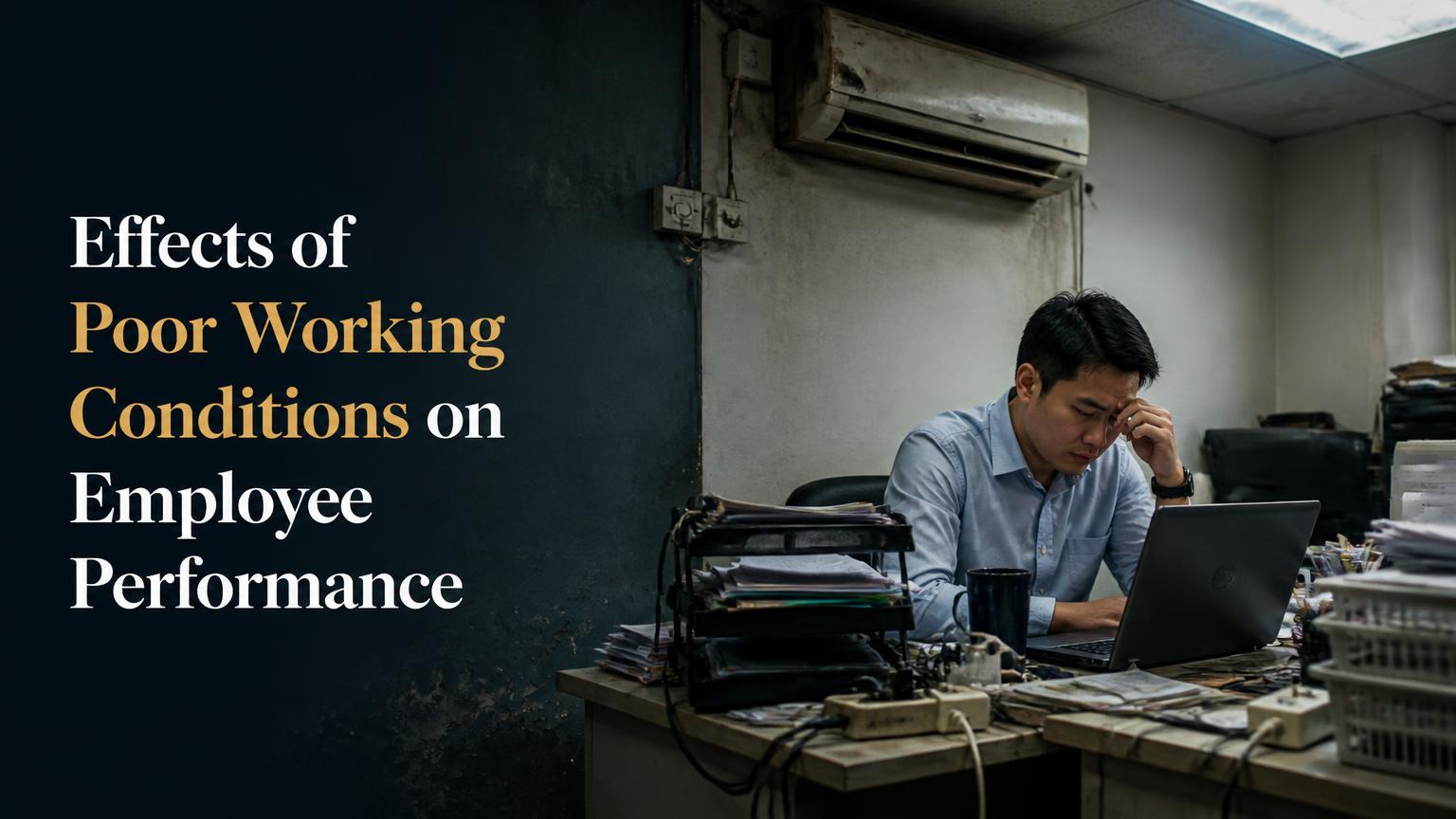
Poor working conditions affect far more than comfort. Excessive noise, unreliable equipment, unsafe spaces, poor communication, unreasonable workloads, and inadequate support can make ordinary tasks harder to complete well. Over time, employees may work more slowly, make more mistakes, withdraw from collaboration, or look for another job. Understanding these effects helps managers identify operational problems before they become performance judgments. It also helps employees describe workplace concerns clearly, connect them to their work, and seek practical improvements rather than being dismissed as simply unmotivated.
Understanding the Effects of Poor Working Conditions on Employee Performance
#1. Reduced Concentration and Focus
Poor working conditions can make it difficult for employees to give sustained attention to important tasks. Constant interruptions, excessive noise, uncomfortable temperatures, poor lighting, crowded workspaces, or frequent equipment problems compete for attention that should be directed toward the work itself.
The result may be slower progress, missed details, and more frequent rechecking. An employee who works in a noisy shared area, for example, may need to reread documents several times or postpone complex work until the end of the day. That does not necessarily indicate poor discipline. It may indicate that the environment is imposing unnecessary cognitive demands.
Managers should observe whether concentration problems occur in particular locations, shifts, or types of work. Asking when and where employees struggle can reveal practical causes. Relocating focused work, reducing avoidable interruptions, improving lighting, or repairing malfunctioning equipment may produce a more useful improvement than simply telling employees to “pay closer attention.”
#2. Lower Work Quality and More Errors
When working conditions create fatigue, confusion, discomfort, or constant disruption, the quality of work can decline. Employees may overlook information, enter data incorrectly, follow a process out of sequence, or submit work without the review it requires.
Errors often have consequences beyond the individual task. A mistake in a customer record can create additional work for colleagues. An incorrect order, missed deadline, or incomplete report can affect clients and place pressure on the next person in the process. If management responds only by criticizing the employee, it may miss a recurring environmental problem.
Review the circumstances surrounding performance issues. Look for patterns related to inadequate tools, unclear instructions, understaffing, poor workspace design, or rushed schedules. A fair response distinguishes between carelessness and conditions that make careful work unnecessarily difficult. Employees should still be accountable for reasonable standards, but accountability works best when the organization supplies the conditions needed to meet them.
#3. Decreased Productivity and Slower Task Completion
Poor conditions can reduce the amount of useful work completed during a shift. Broken systems, limited supplies, slow software, repeated interruptions, and inefficient layouts all create delays. Employees may spend time waiting, searching, correcting, or finding workarounds instead of completing their primary responsibilities.
This lost time is not always visible in performance reports. A task may appear late even though the employee spent part of the day dealing with access problems or waiting for approval. Similarly, a team may seem inefficient when the actual issue is an unreliable process that affects everyone.
Managers can identify this effect by mapping a typical task from beginning to end. Ask where employees wait, repeat work, transfer information manually, or depend on unavailable resources. Employees can strengthen the conversation by recording specific examples: what happened, how long it delayed the work, and what practical change would remove the obstacle. Concrete information is more persuasive than a general complaint that “everything takes too long.”
#4. Higher Stress and Reduced Resilience
Working conditions influence how easily employees can handle ordinary pressure. A demanding assignment may be manageable when expectations are clear, staffing is adequate, and tools function properly. The same assignment can become overwhelming when employees face constant uncertainty, inadequate support, or an unsafe or disrespectful environment.
Stress can affect patience, decision-making, communication, and the ability to recover after a difficult interaction. An employee who is repeatedly interrupted, given conflicting instructions, or expected to work around defective equipment may have less capacity left for careful problem-solving. This can create a cycle in which stress contributes to weaker performance, and weaker performance creates additional stress.
Managers should avoid treating every stress-related performance problem as an individual weakness. Clarify priorities, remove avoidable obstacles, distribute urgent work realistically, and make it clear where employees can ask for help. Employees should also identify the specific conditions creating pressure instead of describing themselves or their colleagues in personal terms. The goal is to address the work situation, not assign a label.
#5. Weaker Communication and Teamwork
Poor working conditions can damage collaboration even when employees remain committed to their colleagues. Crowded spaces, inadequate communication systems, unclear responsibilities, high workloads, and persistent frustration make it harder to exchange information calmly and completely.
For example, a team may stop sharing minor problems because reporting them feels pointless or because everyone is already overloaded. Colleagues may rely on informal shortcuts rather than agreed procedures. Misunderstandings then increase, and employees may blame one another for failures that began with an unclear process or missing resource.
Improving teamwork requires more than telling people to communicate better. Establish clear channels for urgent and routine information, define who owns each step, and create a reliable way to report operational barriers. When discussing a breakdown, focus on the information that was missing, delayed, or misunderstood. A useful question is: “What would have made it easier for the next person to complete their part correctly?”
#6. Lower Motivation and Engagement
Employees are less likely to invest discretionary effort when the workplace repeatedly signals that basic needs are unimportant. Inadequate equipment, unsafe conditions, inconsistent scheduling, poor facilities, or ignored concerns can make employees feel that management expects results without providing reasonable support.
Lower motivation does not always appear as open refusal. It may look like doing only the minimum, avoiding initiative, declining optional responsibilities, or becoming less willing to suggest improvements. Some employees continue meeting formal requirements while becoming emotionally detached from the work.
Managers should not respond by demanding enthusiasm. First, determine whether employees have the resources, information, authority, and time required to do the job properly. Acknowledge legitimate obstacles, act on those that can be addressed, and explain the reasoning when a requested change cannot happen immediately. Visible follow-through matters. Even when a problem cannot be solved at once, a clear update is more constructive than silence.
#7. Increased Absence and Employee Turnover
Persistent poor working conditions can contribute to more absences and increased turnover. Employees may take time away because the work environment is exhausting, unreliable, or difficult to tolerate. Others may decide that another employer offers a more sustainable arrangement.
Absence and turnover create additional performance problems. Remaining employees may absorb extra work, new staff may require training, and service quality may become inconsistent. This can intensify the original conditions, especially when understaffing causes longer hours and greater pressure.
A departure or absence should not automatically be interpreted as proof that the individual lacked commitment. Look for patterns by team, location, shift, supervisor, or job function. Exit feedback, attendance trends, and informal conversations can help identify recurring issues, provided they are handled responsibly and without unsupported assumptions. Managers should also distinguish between a temporary disruption and a workplace condition that has been allowed to continue for months.
What Counts as Poor Working Conditions?
Poor working conditions include more than visibly unsafe or unpleasant physical spaces. They can involve defective tools, inadequate staffing, unreasonable schedules, unclear expectations, inconsistent supervision, weak communication systems, lack of training, or procedures that force employees to repeat avoidable work. A workplace may look clean and professional while still creating serious operational obstacles.
The key question is whether the conditions make it unnecessarily difficult for a reasonable employee to perform the role to the expected standard. Consider the resources available, the demands placed on the employee, and the control the employee has over the problem. If someone cannot complete a task because a required system repeatedly fails, the issue is different from a person choosing not to follow a functioning process.
Employees can describe poor conditions more effectively by connecting them to observable effects. Instead of saying, “The department is badly managed,” they might say, “The scheduling changes have been communicated after shifts begin, so staff arrive without knowing which priorities take precedence.” This approach keeps the discussion specific, fair, and easier to act upon.
How to Respond to Performance Problems Caused by Working Conditions
When performance declines, begin by separating the observed result from the assumed cause. State what happened, when it happened, and what impact it had. Then ask whether any workplace condition made the expected performance difficult. This does not remove accountability; it improves the accuracy of the response.
A practical review should consider:
- Whether the employee has functioning tools and sufficient information.
- Whether workload, staffing, and deadlines are realistic.
- Whether instructions or priorities conflict.
- Whether the issue affects one person or several employees.
- Whether the condition is temporary, recurring, or worsening.
- What change would make the expected performance more achievable.
Managers should address problems within their authority and escalate matters that require facilities, technology, operations, HR, or senior leadership involvement. They should also set a follow-up date rather than assuming that raising the issue has solved it.
Employees should keep their records factual and proportionate. Note dates, examples, work impacts, and previous attempts to resolve the issue. Avoid exaggeration, personal accusations, or claims about motives. If the condition involves safety, harassment, discrimination, or another serious concern, use the organization’s established reporting channels and seek appropriate internal guidance.
A Practical Conversation About Working Conditions
A focused conversation can prevent a legitimate concern from becoming a vague argument about attitude or performance. Choose a private setting, bring specific examples, and explain the effect on the work. The purpose is to identify a barrier and agree on a reasonable next step.
An employee might say:
I want to discuss a condition that is affecting my ability to complete the weekly reports accurately. The shared system has been unavailable several times this month, and I have had to recreate entries manually. That has delayed submissions and increased the chance of errors.
Could we agree on what I should do when the system is unavailable, and could the recurring problem be raised with the technology team? I can provide the dates and examples I have recorded.
A manager responding to a performance concern can use the same principle:
I noticed that the last two reports were submitted after the agreed deadline. I want to understand what affected the timing before we decide how to address it. Were there problems with the process, the workload, or the information you received?
Let’s identify what needs to change and agree on the next deadline. I also need you to tell me promptly if the same obstacle occurs again so we can address it before the work becomes overdue.
The wording should be adapted to the situation. Avoid promising an immediate solution if you do not control the relevant resource. Instead, clarify what will happen next, who is responsible, and when the issue will be reviewed.
Closing Thoughts
The effects of poor working conditions on employee performance are often mistaken for individual carelessness, weak motivation, or a lack of commitment. A more responsible approach examines the environment as well as the person. Managers should identify practical barriers, maintain fair standards, and follow through on reasonable improvements. Employees should describe conditions with specific examples and connect them to measurable work effects. The next useful step is to choose one recurring obstacle, document its impact, and begin a focused conversation about what can change.