
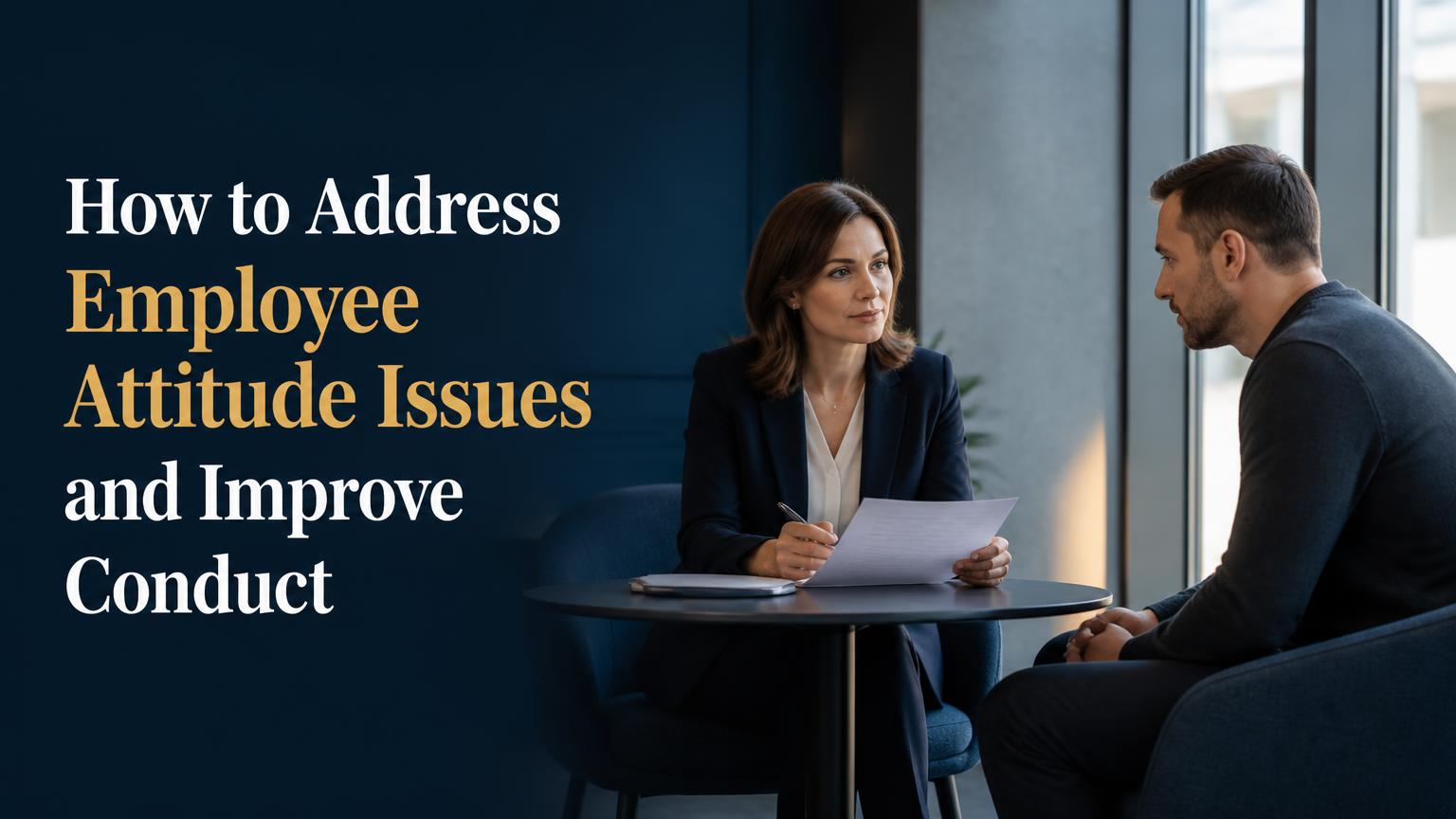
Employee attitude issues can affect communication, morale, customer service, and the team’s ability to get work done. Yet “bad attitude” is often too vague to guide a fair response. A manager must look beyond irritation or hearsay and identify the specific conduct creating the problem. The most effective approach combines direct conversation, careful listening, clear expectations, consistent follow-up, and appropriate accountability. The goal is not to force a particular personality or emotional style. It is to address behavior that interferes with respectful, reliable, and productive work.
How to Address Employee Attitude Issues in Practice
#1. Define the Conduct Instead of Labeling the Employee
Begin by translating the phrase “attitude problem” into observable behavior. An employee who seems negative may actually be asking legitimate questions, challenging an unclear decision, or responding to a workload problem. Another employee may be interrupting colleagues, using a disrespectful tone, refusing reasonable instructions, or making discouraging comments in front of customers. Those situations require different responses.
Before speaking with the employee, write down what you personally observed or what reliable information has been reported. Include the date, setting, words or actions involved, and the effect on work. Avoid conclusions such as “She is hostile” or “He does not care.” Instead, describe conduct: “During Monday’s team meeting, you interrupted two coworkers and said the new process was pointless before they finished explaining it.”
This distinction protects fairness and makes the discussion practical. Employees can respond to a specific event or pattern. They cannot meaningfully correct a vague judgment about their character.
#2. Separate a Single Incident From a Recurring Pattern
Not every difficult interaction represents an ongoing employee attitude issue. Someone may have had a stressful day, misunderstood a request, or reacted poorly to an unusual circumstance. A repeated pattern deserves a more structured response than an isolated lapse, especially when the employee otherwise meets expectations.
Review the context before arranging a corrective conversation. Consider whether the behavior occurred once or several times, whether others contributed to the situation, and whether expectations were previously explained. Also check whether the employee has recently experienced a change in duties, schedule, supervision, or workload that may help explain the conduct without excusing it.
This review is not an attempt to find reasons to avoid accountability. It helps you choose a proportionate response. A first minor incident may call for a timely coaching conversation. Repeated disrespect, refusal to cooperate, or conduct that harms customers or colleagues may require documented performance management under your organization’s established procedures.
#3. Hold a Private, Direct Conversation
Address the concern privately and reasonably soon after the relevant incident. Waiting for frustration to build can lead to an overly emotional discussion, while confronting the employee in front of coworkers can create embarrassment and defensiveness. Choose a setting where you can speak without interruption and allow enough time for a real exchange.
Use a simple structure: describe the behavior, explain its impact, invite the employee’s perspective, and state the expectation going forward. Keep your tone calm and avoid exaggerations such as “you always” or “you never.” The purpose is to correct conduct, not to win an argument.
You might say:
I want to discuss what happened during yesterday’s meeting. When Jordan was presenting, you interrupted several times and said the proposal was a waste of time. That made it difficult for the group to hear the full proposal and shifted the discussion away from the decision we needed to make.
I’d like to understand what was happening from your perspective. I also need us to agree that concerns will be raised without interrupting or dismissing another employee’s contribution.
A direct conversation gives the employee a fair opportunity to explain while making clear that an explanation does not automatically remove the expectation.
#4. Listen for Relevant Causes Without Excusing the Conduct
After describing the concern, listen carefully. The employee may identify a misunderstanding, an operational obstacle, conflicting instructions, a workload issue, or a concern about how a decision was made. Listening does not mean accepting every explanation as valid. It means gathering enough information to respond intelligently.
Ask focused questions rather than inviting an unstructured complaint. Useful questions include:
- “What was your understanding of the instruction?”
- “What led you to respond that way in the meeting?”
- “Is there information or support you believe is missing?”
- “Has this issue occurred before, and if so, what happened?”
- “What would help you handle a similar situation more constructively?”
Acknowledge legitimate concerns specifically. If the employee received contradictory directions, correct the process. If the workload is unreasonable, examine priorities. If the employee simply disagrees with a decision, explain how disagreement can be expressed professionally.
You can recognize the concern while maintaining the standard: “I understand that you disagreed with the decision. You are still expected to raise that disagreement respectfully and follow the decision once it has been made.”
#5. Set Clear Behavioral Expectations
Do not end the conversation with “Please improve your attitude.” That instruction is too subjective. Explain what acceptable conduct looks like in situations the employee is likely to encounter. Clear expectations should be specific enough that both of you can later determine whether improvement occurred.
Depending on the issue, expectations might include:
- Allowing colleagues to finish speaking before responding.
- Raising concerns privately or through the appropriate meeting process.
- Using a neutral, respectful tone with customers and coworkers.
- Following reasonable instructions or asking clarifying questions before refusing.
- Avoiding sarcastic, dismissive, or insulting comments.
- Participating in required work without deliberately disrupting others.
- Bringing disagreements to the manager rather than recruiting coworkers into repeated complaints.
Ask the employee to summarize the expectations in their own words. This can reveal misunderstanding and creates a clearer record of what was discussed. If the issue is serious or recurring, put the expectations and follow-up date in writing according to normal workplace procedures.
The standard should concern professional behavior, not forced enthusiasm. Employees do not have to appear cheerful at all times, but they do need to communicate and perform their work without creating avoidable disruption or disrespect.
#6. Agree on Support and Consequences
Improvement is more likely when the employee understands both the available support and the consequences of continued conduct. Support might involve clarifying priorities, providing training, adjusting a communication process, pairing the employee with a more experienced colleague, or scheduling a follow-up meeting. Offer only support that is realistic and within your authority.
At the same time, do not make accountability conditional on the employee feeling satisfied. Workplace expectations still apply when an employee dislikes a decision, has a difficult personal day, or believes another person was treated more favorably. If the conduct continues, explain what the next step may be under your organization’s policies and procedures. Do not threaten penalties you cannot impose or make promises about outcomes you do not control.
A useful closing might sound like this:
I will clarify the project priorities in writing and check in with you next week. From now on, I expect concerns to be raised without interrupting or making personal remarks. If the same conduct continues, we will need to address it through the next stage of our performance process.
You do not have to agree with every decision, but you are responsible for how you communicate your disagreement and how you carry out the work.
This combination of support and consequences is more credible than either harshness or indefinite patience.
#7. Follow Up Consistently and Escalate When Necessary
A corrective conversation is not complete simply because it happened. Set a reasonable follow-up point and observe whether the conduct changes. Look for specific evidence: fewer interruptions, more respectful responses, improved cooperation, or compliance with agreed procedures. Also notice improvement and acknowledge it briefly. Recognition does not erase the original issue, but it reinforces the behavior you want repeated.
Keep factual notes about significant conversations, expectations, follow-up dates, and observed developments. Avoid emotional descriptions or speculation about motives. Documentation helps you maintain consistency and gives the employee a clearer account of what has been addressed.
If the behavior improves, continue normal supervision rather than repeatedly reopening the issue. If it does not improve, or if the conduct involves threats, harassment, discrimination, serious insubordination, retaliation, or major customer harm, consult HR or the appropriate internal resource promptly. Follow established procedures and apply standards consistently across employees. Escalation should be based on conduct and workplace impact, not on whether a manager personally likes the employee’s personality.
A Practical Example of Addressing an Attitude Concern
Suppose an experienced employee has begun responding to routine requests with sarcasm. In team meetings, the employee rolls their eyes, interrupts newer colleagues, and says that management “never listens anyway.” Several coworkers have become reluctant to contribute, but no one incident alone appears severe.
A manager should not open with, “Your attitude is damaging the team.” That statement may reflect the manager’s concern, but it does not identify what needs to change. Instead, the manager could describe two or three recent examples, explain the effect, and ask for the employee’s perspective.
I want to discuss a pattern I’ve noticed over the past two weeks. In Tuesday’s meeting, you interrupted Priya twice and said that the new reporting process was pointless. On Thursday, when I asked for your input, you rolled your eyes and told the group that management never listens. Several people stopped participating after that.
I want to understand whether there is a concern behind these responses. At the same time, dismissive comments and interruptions are not acceptable in team discussions. Concerns need to be stated directly and respectfully so the group can work through them.
The employee may explain that the process creates duplicate work. If that concern is valid, the manager should examine it rather than dismissing it. The manager can then separate the two issues: “The duplicate work needs review, and your concerns are welcome. The way you raised them still needs to change.”
The follow-up expectation might be that the employee allows others to finish, raises process concerns with examples, and avoids personal or dismissive remarks. The manager can schedule a check-in after the next two meetings and record whether the agreed changes occur.
This approach neither ignores disruptive behavior nor treats disagreement as misconduct. It addresses the conduct while preserving room for useful criticism.
When the Employee Disagrees With Your Feedback
An employee may deny the behavior, argue that others do the same thing, or say the manager is targeting them. Do not turn the conversation into a contest over whose feelings are more valid. Return to the specific conduct and the standard that applies.
If the employee says, “I was only being honest,” respond by distinguishing honesty from delivery: “You are expected to raise concerns honestly. Honesty does not require interrupting someone or describing their work as worthless.” If the employee says, “Everyone is too sensitive,” return to impact and expectations: “People may respond differently, but the interruptions and dismissive comments are interfering with the meeting. The expectation remains the same.”
If the employee raises a comparison with a coworker, take the concern seriously without abandoning the current discussion. You can say that you will review the other situation separately, but that it does not excuse the conduct being addressed now.
If the employee becomes angry, pause if necessary and keep the boundary clear. A manager can say:
I’m willing to continue this conversation, but I’m not willing to be shouted at or insulted. We can take a short break and resume when we can speak respectfully.
Where the discussion involves serious allegations, potential retaliation, harassment, discrimination, threats, or a formal performance process, involve HR or another designated resource rather than attempting to manage the matter alone.
Closing Thoughts
Addressing employee attitude issues requires more precision than telling someone to be more positive. Identify the conduct, examine the context, discuss it privately, listen without surrendering standards, and define the behavior required going forward. Then provide reasonable support, document important steps, and follow up consistently. Fairness means holding employees accountable for observable workplace behavior while allowing legitimate disagreement and concerns to be heard. A calm, specific, and proportionate response gives the employee a genuine opportunity to improve and gives the manager a sound basis for further action if improvement does not occur.