
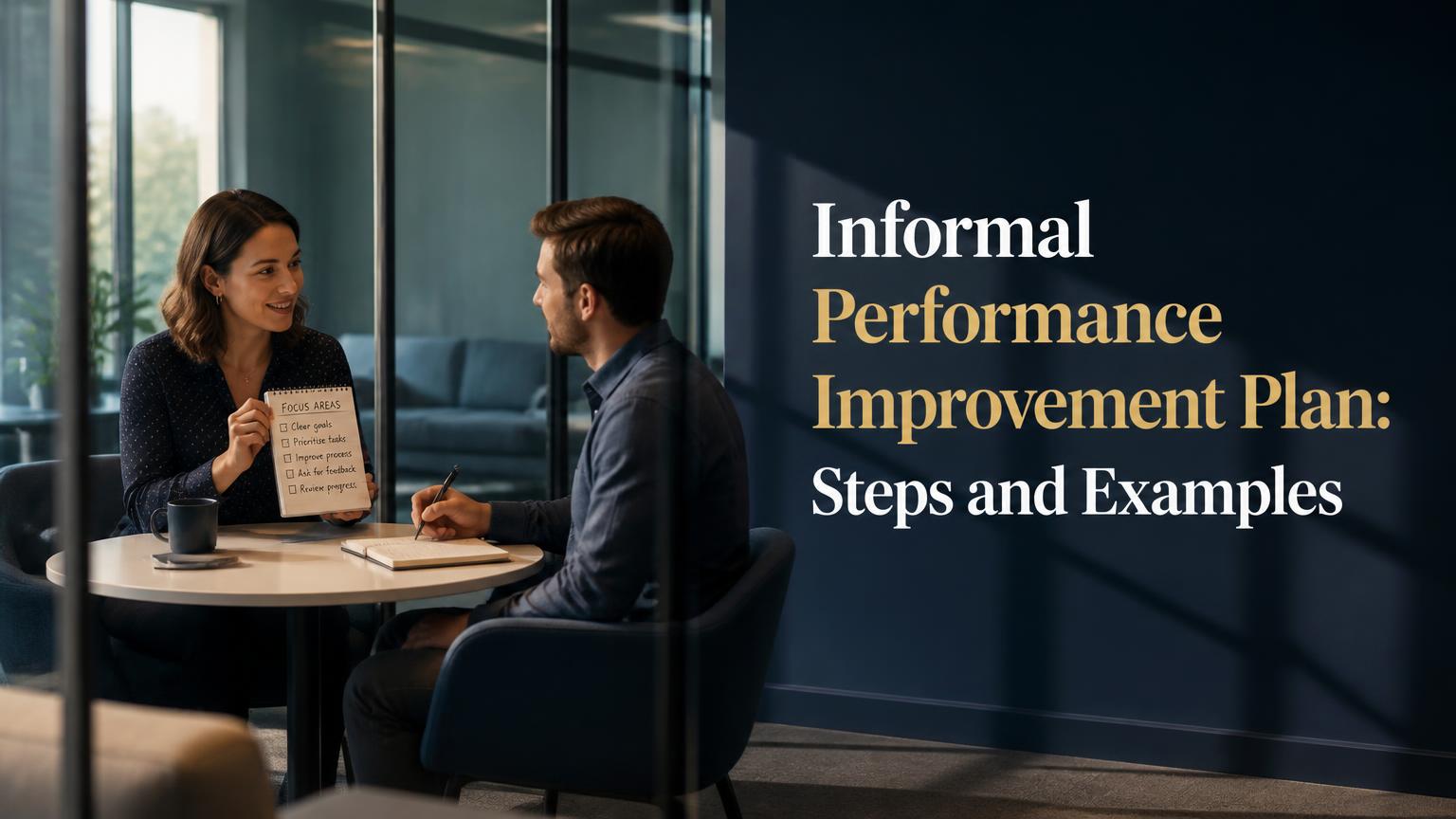
When an employee’s performance falls short, managers often face a difficult choice: address the problem immediately or wait until it becomes serious enough for formal disciplinary action. An informal performance improvement plan can provide a practical middle ground. It gives the employee clear expectations, reasonable support, and a defined opportunity to improve without treating an early concern as a final judgment. Used properly, it also helps the manager replace vague criticism with observable facts and agreed actions. The steps below explain how to create, discuss, and follow up on an informal plan fairly.
How to Create an Informal Performance Improvement Plan
#1. Identify The Specific Performance Concern
Begin with a precise description of the performance issue. Avoid labels such as “unmotivated,” “careless,” or “not a team player,” because they describe an interpretation of the employee rather than conduct that can be evaluated. Focus on what happened, when it happened, and how it affected the work, team, customer, or deadline.
For example, “The last three weekly reports were submitted one to two days late” is more useful than “Your time management needs improvement.” Specific information gives the employee a fair opportunity to respond and prevents the plan from becoming a collection of general criticisms.
Before speaking with the employee, review the relevant facts. Check whether expectations were clearly communicated, whether the workload or instructions changed, and whether other employees faced similar circumstances. An informal performance improvement plan should address a genuine performance gap, not compensate for unclear management.
#2. Confirm The Expected Standard
An employee cannot reasonably improve without knowing what acceptable performance looks like. State the expected standard in practical terms, including the required quality, deadline, frequency, or behavior. If the standard comes from a written procedure, job description, project agreement, or team process, refer to it directly.
A useful expectation might be: “Client follow-up emails should be sent within one business day and should include the agreed summary and next steps.” That standard is easier to understand and measure than “Communicate more effectively.”
Also check whether the expectation is realistic. Consider the employee’s training, available tools, workload, authority, and dependencies on other people. Accountability is important, but fairness requires the manager to distinguish between a failure to perform and an obstacle the organization has not addressed.
#3. Prepare For A Private And Balanced Conversation
Plan the conversation before scheduling it. Gather a few representative examples, identify the effect of the performance issue, and decide what improvement would look like over the next several weeks. Do not arrive with an overwhelming list of every frustration accumulated over months. The purpose is to address a defined concern and establish a workable path forward.
Hold the discussion privately and allow enough time for the employee to respond. A manager may open the conversation in a direct but non-accusatory way:
I want to discuss a performance concern and agree on a practical way to address it. Over the past month, three project updates were submitted after the agreed deadline, which delayed the review process for the rest of the team.
I’d like to hear your perspective before we decide on next steps. Then we can clarify the expectation, identify any support you need, and set a date to review progress.
Listen for relevant information without turning the meeting into an argument about intentions. The employee may identify unclear instructions, competing priorities, insufficient training, or a genuine mistake. Listening does not remove accountability; it helps ensure that the plan addresses the actual problem.
#4. Explain That The Plan Is Informal
Be clear about the purpose and status of the document. An informal performance improvement plan is generally a structured coaching tool, not necessarily a formal disciplinary notice. However, the exact meaning may differ between organizations, so managers should follow their established procedures and consult HR or the appropriate internal resource when needed.
Explain that the plan records the concern, the expected improvement, the support available, and the review schedule. Avoid presenting it as a threat or pretending that there can never be further consequences. A fair explanation might be:
This is an informal improvement plan intended to give you clear expectations and support. It is not a conclusion that you cannot succeed in the role. We will review your progress on the dates listed, and we will address any continuing concerns through the appropriate process.
The employee should understand what the plan does and does not mean. Do not use “informal” to avoid documentation, and do not use the plan to surprise someone with expectations that were never discussed.
#5. Set Measurable Improvement Goals
Convert the concern into a small number of measurable goals. Each goal should state what the employee must do, the required standard, and the period in which improvement will be assessed. Three focused goals are usually more useful than a long catalogue of deficiencies.
For example:
- Submit all weekly status reports by noon each Friday for the next six weeks.
- Include project risks, completed work, and next steps in every report.
- Notify the manager at least one business day before the deadline if an obstacle may prevent timely submission.
The goals should measure performance rather than personality. “Demonstrate a better attitude” is difficult to assess consistently. “Raise concerns about project obstacles during the weekly planning meeting or in writing before the deadline” describes an observable action.
Include a review period that is long enough to show a pattern but short enough to provide timely feedback. The appropriate period depends on the work. A customer-service behavior may be reviewed weekly, while a complex project deliverable may require several weeks or milestones.
#6. Provide Support And Agree On Follow-Up
Improvement is not solely the employee’s responsibility if the manager controls necessary resources or clarification. Identify what support will be provided and who will provide it. Support might include refresher training, a written checklist, access to a subject-matter expert, clearer priority discussions, or regular brief check-ins.
Put the follow-up schedule in writing. A plan might include a short weekly meeting, a midpoint review, and a final assessment. During each check-in, discuss what has improved, what remains difficult, and whether the original expectations still reflect the work.
A manager could say:
For the next four weeks, we’ll spend fifteen minutes every Tuesday reviewing your open tasks and upcoming deadlines. I’ll also provide the reporting checklist today and arrange a refresher session on the client-tracking system.
Please bring examples of anything that is unclear or preventing you from meeting the standard. Our next formal review will be on June 12, but we should discuss concerns as they arise rather than waiting until then.
Follow-up should be active rather than ceremonial. If the manager never provides feedback until the final meeting, the plan becomes less useful and may feel unfair.
#7. Document The Agreement And Evaluate Progress Fairly
After the conversation, create a concise written summary. Include the performance concern, relevant examples, expected standards, goals, support, review dates, and the possible next steps if improvement does not occur. Give the employee a chance to correct factual errors or add relevant context.
Documentation should be factual and professional. Record what was observed and agreed, not speculation about the employee’s character or motives. If the employee disagrees with the assessment, note the disagreement and consider whether additional information needs to be reviewed.
At each review, evaluate the agreed measures consistently. Recognize genuine improvement, address partial progress specifically, and do not move the goalposts by introducing unrelated criticisms without a fair discussion. If the employee meets the expectations, close the informal plan or return to ordinary performance management. If concerns continue, consult HR or the appropriate internal resource before deciding what process should follow.
Informal Performance Improvement Plan Examples
The best informal plans are adapted to the type of work involved. The examples below illustrate how a vague concern can become a clearer performance discussion and a practical improvement plan.
Example: Missed Deadlines
A manager notices that an analyst has submitted several routine reports late. Before creating the plan, the manager checks whether the deadlines were clear and whether the analyst received the necessary data from other departments. The manager finds that the deadlines were documented, but the analyst has not been escalating delays early enough.
The plan might require the analyst to submit the report by 3 p.m. each Thursday for the next five weeks, use the standard reporting checklist, and notify the manager by noon on Wednesday if required information is missing. The manager provides a short planning template and reviews progress each Friday.
This approach addresses the actual gap—late delivery and delayed communication—rather than accusing the analyst of being disorganized.
Example: Incomplete Or Inaccurate Work
A supervisor sees recurring errors in order-entry records. Instead of writing “Improve accuracy,” the supervisor identifies the pattern: product codes are frequently entered incorrectly, and required customer notes are sometimes omitted.
The informal plan could require the employee to use a verification checklist for every order, complete a refresher session with an experienced colleague, and maintain an error rate below an agreed level during the next month. The supervisor reviews a sample of completed orders each week and discusses errors promptly.
The employee should also have an opportunity to explain whether the system is confusing, the training was insufficient, or the workload makes verification difficult. The plan can then include a system guide or temporary quality check without removing the employee’s responsibility.
Example: Disruptive Meeting Conduct
A team leader receives complaints that an employee frequently interrupts colleagues during project meetings. The leader should not assume the employee intends to undermine others. Instead, the leader can describe the observed behavior and its effect: colleagues have been cut off before finishing their updates, and the meeting has become harder to manage.
An informal plan might ask the employee to allow speakers to finish, record questions until the appropriate discussion point, and raise disagreements using specific evidence rather than personal remarks. The leader can review meeting behavior over four weeks and ask the employee for their perspective after each major meeting.
If the issue involves serious harassment, threats, discrimination, or repeated misconduct, the manager should use the organization’s established reporting and response procedures rather than treating the matter as ordinary coaching.
Sample Informal Performance Improvement Plan Template
A short written plan is often more effective than a lengthy document filled with formal language. The following structure can be adapted to the employee’s role and the organization’s procedures.
Employee: [Name]
Manager: [Name]
Date: [Date]
Review period: [Start date] to [End date]Performance concern
During [period], [describe the observable performance issue and provide specific examples]. The effect has been [describe the effect on work, customers, deadlines, colleagues, or quality].Expected standard
The expected standard is [describe the required behavior, quality, deadline, or outcome].Improvement goals
- [Specific, measurable goal]
- [Specific, measurable goal]
- [Specific, measurable goal, if needed]
Support provided
The manager will provide [training, checklist, check-ins, clarification, resources, or other relevant support].Review schedule
Progress will be discussed on [dates or frequency]. The employee and manager will address obstacles as they arise rather than waiting for the final review.Possible next steps
If the agreed improvement is not demonstrated, the manager will consult the appropriate internal process and discuss the next steps with the employee.Employee comments
[Space for the employee’s response, corrections, or additional context.]Acknowledgment
Employee signature: __________ Date: ________
Manager signature: __________ Date: ________
An acknowledgment signature should normally confirm that the employee received or discussed the plan, not necessarily that the employee agrees with every statement. If the employee refuses to sign, follow the organization’s documentation practice and record that the plan was presented.
When An Informal Plan Needs A Different Approach
An informal performance improvement plan is most useful for a defined performance gap that may improve through clear expectations, support, and follow-up. It may not be the right first response when the issue involves an urgent safety risk, serious misconduct, threats, harassment, discrimination, retaliation, or a matter covered by a specific internal procedure. Those situations may require prompt escalation to HR, compliance, security, or another responsible authority.
Managers should also avoid using an informal plan to disguise a decision that has already been made. If termination, demotion, or formal discipline is effectively predetermined, presenting the plan as a genuine opportunity to improve is misleading. The employee deserves an honest explanation of the process being used.
Before proceeding, ask three practical questions:
- Is the concern based on documented, observable facts?
- Has the employee had a reasonable opportunity to understand the expectation?
- Can the manager provide a fair opportunity and meaningful support for improvement?
If the answer to any question is no, correct that weakness first. A plan built on unclear expectations or incomplete facts is unlikely to resolve the problem and may create a larger workplace dispute.
Closing Thoughts
An informal performance improvement plan works best when it is specific, proportionate, and genuinely focused on improvement. Describe observable conduct, clarify the required standard, listen to relevant context, provide practical support, and review progress consistently. The document should not be a threat or a box-checking exercise; it should be a shared record of what must change and how success will be assessed. Start with one clearly defined concern, agree on measurable next steps, and follow through with the fairness and consistency the process requires.